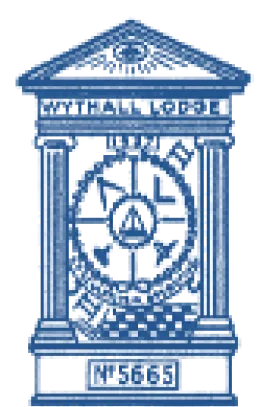
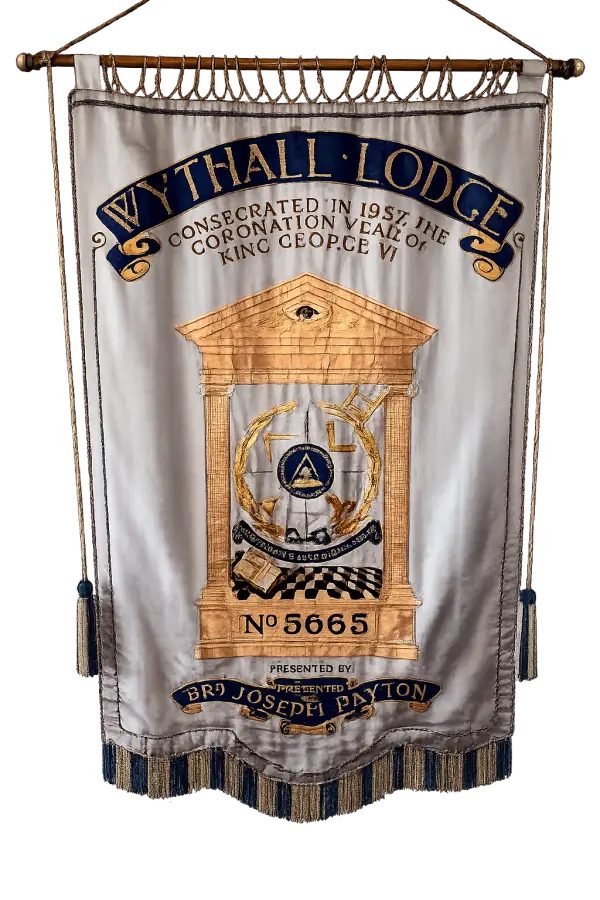
Every Masonic lodge treasures its banner, and Wythall Lodge No. 5665 has a particularly fine one: embroidered in blue and gold, consecrated with the Lodge in 1937, and crowded with meaning from top to bottom. This page reads the banner as its own designer intended it to be read—drawing on a paper delivered to the Lodge, The Symbolism of the Banner of the Wythall Lodge No. 5665, by W. Bro. Gordon Frazier, which survives among the Lodge’s papers in the Worcestershire Masonic Library and Museum.
Why a Lodge Has a Banner
Banners are older than Freemasonry. In the Volume of the Sacred Law they appear as ensigns and standards: in the Book of Numbers, Moses and Aaron are told that “every man of the children of Israel shall pitch by his own standard, with the ensign of their father’s house.” That is the whole reason for a banner—a visible rallying point for those of the same system and the same principles.
An army keeps the idea alive: each regiment has its Sovereign’s Colour and its Regimental Colour. A lodge banner is a rallying point in just the same sense. When a Provincial Grand Lodge is opened and closed, it is part of the Provincial Grand Pursuivant’s duty to see the brethren ranged under their respective banners—a spectacle that modern conditions have made rarer than it once was, but never less meaningful.
Our Banner — Who Made It, and Why It Is a Doorway
The banner was presented to the Lodge by Bro Joseph Payton—whose name is embroidered along its foot, and who appears as J. Payton in the 1938 sketch of the founding brethren. The design owed most to W. Bro. Frank Russon, the Lodge’s first Secretary; and, as Frazier gently observed, it was perhaps more as an operative mason—a builder in stone—than as a speculative one that he drew it.
For the design he chose is a doorway. The whole banner takes the appearance of an entrance—a temple portico—and for the initiates of Wythall Lodge it marks their own entrance into Freemasonry. There is a nice touch of Lodge history in the choice, too: the founders themselves met the cost of the portico of the building in which the Lodge first met, so the doorway on the banner was, in a sense, their own gift rendered in silk and gold thread.
Reading the Banner, Piece by Piece
Look at the banner and almost every element carries a lesson. Here is the reading W. Bro. Frazier gave the Lodge, following the design from its frame inward to its centre.
The entrance — wisdom in the columns
The frame of the design is an entrance: two side pilasters supporting a frieze, an entablature and a pediment. The capitals of the pilasters, with their scrolled volutes, are of the Ionic Order—which in the Craft has always signified Wisdom, and alludes to the wisdom of King Solomon in building, completing and dedicating the Temple at Jerusalem to the service of the Great Architect of the Universe. Here it speaks of the wisdom of the founders who contrived and consecrated the Lodge to the double service of Freemasonry and charity.
The All-Seeing Eye
In the tympanum of the pediment—the triangle at the very top—is the All-Seeing Eye. Every time a brother looks at it he is meant to remember that wherever we are and whatever we do, the Great Architect is with us, and His all-seeing eye observes us; and that while we act in conformity with the principles of the Craft, we should not fail to discharge our duty to Him with fervency and zeal.
The chequered pavement
At the base of the central portion is a piece of black-and-white flooring—the chequered pavement. It stands for light and darkness, and for the joys and sorrows of our chequered existence: the plain truth that no life is all of one colour.
The Volume of the Sacred Law and Jacob’s Ladder
To one side lies the open Holy Bible—to Freemasons the Volume of the Sacred Law, the greatest of the three great lights, the unerring standard of truth and justice. From it rises Jacob’s Ladder, which stretches up to heaven; by it we hope, symbolically, to ascend to those immortal mansions whence all goodness emanates. Its many staves are the many moral virtues, and the three principal ones are Faith, Hope and Charity—faith in the Great Architect, hope in salvation, and charity with all mankind. The ladder rests upon the Volume of the Sacred Law, because belief in the divine precepts it contains is what lets us climb the first step.
The motto — “Speculative and Operative”
Across the design runs the Lodge motto, “Speculative and Operative.” Not every member is a working mason, but there are other things to build with than brick and stone: we can all be builders of character by example, and continue to raise up a lodge with the finest traditions—one it should be an honour to belong to.
The laurel wreath and the four working tools
The inner emblem is ringed by a circle of laurel leaves tied with a ribbon, and that circle is divided into four, each quarter holding one of the principal working tools.
The upper divisions carry the two other great emblematical lights, the square and the compasses. The square represents matter, and teaches us to regulate our actions; the compasses represent our spiritual nature, and remind us to keep within due bounds with all mankind—for however far one arm of the compass travels, the other stays fixed at the centre, like the divine spark within us.
The lower divisions carry the gavel and the level. The gavel is an emblem of power, reminding us that the Lodge is ruled by the Master and his Wardens, and standing also for the force of conscience that should keep our words and actions unpolluted. The level teaches equality—that whatever talents we have been blessed with, a time will come when all distinctions save those of goodness and virtue shall cease.
The centre — the perfect ashlar
At the very heart of the design, like a point within a circle, where a brother cannot err, is the perfect ashlar: the polished stone that represents what every brother should strive to become—a man shaped from the rough ashlar by the chisel of education, his mind cultivated by a well-spent life in love and charity with his neighbours.
“When the banner is before you, look at it with eyes that see beyond the material, and let it give you a message.”
— W. Bro. Gordon Frazier, on the banner of Wythall Lodge
Source & Acknowledgement
The reading of the banner on this page follows The Symbolism of the Banner of the Wythall Lodge No. 5665 in the Province of Worcestershire, a paper by W. Bro. Gordon Frazier. The paper survives among the “Papers relating to Wythall Lodge No 5665” (accession 1952/5) held by the Worcestershire Masonic Library and Museum, whose care of the Lodge’s early records we gratefully acknowledge.
The banner itself is the primary source for the Lodge’s consecration in 1937, described upon it as “the coronation year of King George VI,” and for its presentation by Bro Joseph Payton. You can read more about the Lodge’s early years, and see the 1938 portrait of the founding brethren, on our history page.