Freemasonry is one of the world’s oldest social and charitable societies, yet it is often poorly understood—in part because Freemasons have historically said so little about themselves. This page sets out, plainly and accurately, what Freemasonry is, where it came from, who may join, and how to join the Freemasons in Birmingham and Solihull. Where we state a fact, we have drawn it from the United Grand Lodge of England and other recognised authorities, which are linked throughout and listed at the foot of the page.
How to Join the Freemasons in Birmingham
If you are wondering how to become a Freemason in Birmingham, the short answer is that you simply ask: a brief note to our Secretary is the first step, and the rest of this page explains everything that follows.
Wythall Lodge draws its members from across Birmingham, Solihull and north Worcestershire, and we meet a short drive from the city at Knowle Masonic Centre on the third Monday of the month, October to April (except December). To become a Freemason in Birmingham you need only be a man of eighteen or over, of good character, who holds a belief in a Supreme Being—you need not be invited, you need not already know a member, and you need not be a man of means. If that describes you, write to our Secretary: there is no obligation on either side, and no one will press you.
What is Freemasonry?
Freemasonry is a society of men concerned with moral and spiritual values. Its members are taught its principles by a series of ritual dramas, which follow ancient forms and use the customs and tools of the medieval stonemason as allegorical guides. A Freemason is encouraged to be a good citizen: to practise charity, to care for his own and for the community as a whole, and to hold to high standards in his public and private life.
Three great principles have guided Freemasonry for centuries, and they are worth stating in the order’s own terms:
Brotherly Love
Every true Freemason shows tolerance and respect for the opinions of others, and behaves with kindness and understanding to all.
Relief
Freemasons are taught to practise charity and to care—not only for their own, but for the community as a whole, by both charitable giving and voluntary effort.
Truth
Freemasons strive for truth, requiring high moral standards and aiming to achieve them in their own lives.
Freemasonry is not a religion, nor a substitute for one. It demands of its members a belief in a Supreme Being, but it is open to men of all faiths, and the discussion of religion—and of politics—is forbidden at lodge meetings. That single rule is one reason men of very different backgrounds and convictions have sat together as friends within it for three hundred years. If you would like the fuller story—the history, the meetings, the myths—our page What is Freemasonry? answers it in plain English.
A Short History
Organised Freemasonry as we know it began in London. On St John’s Day, 24 June 1717, four old London lodges met at the Goose and Gridiron alehouse in St Paul’s Churchyard, formed themselves into the first Grand Lodge of England, and elected Anthony Sayer as their first Grand Master. From that gathering Freemasonry spread across Britain and, with the Empire and through trade, across the world.
For much of the eighteenth century there were two rival Grand Lodges in England—the original body, nicknamed the “Moderns,” and a later one calling themselves the “Antients.” After years of negotiation the two were reconciled, and on 27 December 1813 they joined to form the United Grand Lodge of England (UGLE) at Freemasons’ Hall in London. UGLE, together with the Grand Lodges of Scotland and Ireland, remains one of the three oldest and most senior Masonic authorities in the world.
Today the United Grand Lodge of England has over 200,000 members meeting in more than 6,800 lodges, organised into Provinces that broadly follow the old county boundaries. Wythall Lodge No. 5665 is one such lodge, working under the Provincial Grand Lodge of Worcestershire. The Lodge was consecrated in 1937, and a good deal of its early history—its consecration papers, its founders’ jewels and decades of summonses—is preserved in the Worcestershire Masonic Library and Museum.
The Three Degrees
A man joins Freemasonry through three ceremonies, called degrees, which he takes one at a time over a period of months. Each is a step in a continuous story of self-improvement, and each builds on the last.
- IEntered Apprentice. The first degree, in which a candidate is initiated and introduced to the principles of the order.
- IIFellow Craft. The second degree, concerned with the development of the mind and the pursuit of knowledge.
- IIIMaster Mason. The third degree, the highest in Craft Freemasonry, after which a member is a full Master Mason and may go on to hold office in his lodge.
Beyond the Craft there are many further orders a Master Mason may later choose to join, but the three degrees above are the foundation, and they are common to every regular lodge in England.
The Square, the Compasses — and the Letter G
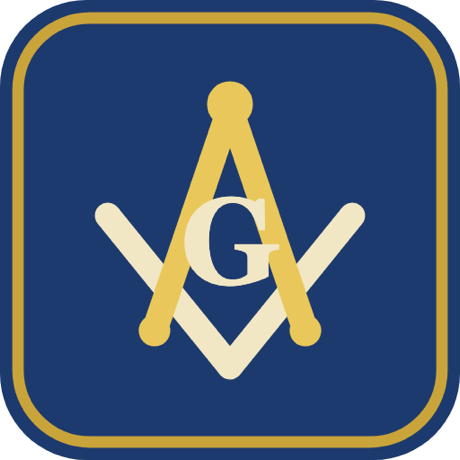
The square and compasses is the most widely recognised emblem of Freemasonry the world over. Yet look closely and you will find it drawn two ways—and the difference says something about where a lodge belongs.
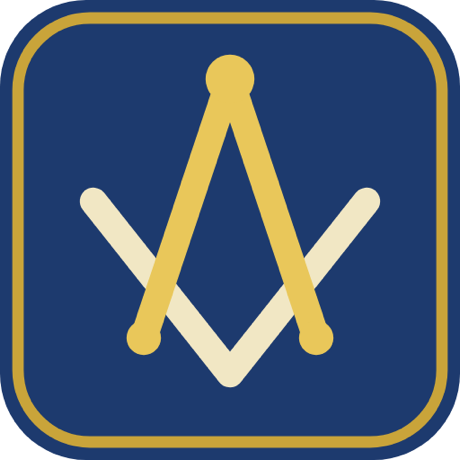
The two tools carry the moral lesson at the heart of the Craft. The square—the stonemason’s try square—teaches us to “square our actions,” to be honest and upright; to be “on the square” is to be a man of integrity. The compasses teach us to circumscribe our desires and keep our passions within due bounds. Together they ask a Mason to measure his conduct as carefully as an architect measures his work.
The letter G carries a double meaning. Its older sense is Geometry—to the old operative masons the first and noblest of the sciences, the art by which a cathedral is raised true. Its later and now firmly settled sense is God, the Grand Geometrician of the Universe, before whom all Freemasons are equal whatever their faith.
Here is the point of interest for the curious. It is a common belief that English Freemasons simply do not use the letter G—but that is not quite right. In English ritual the G is revered: it belongs to the Second Degree, the degree of the Fellow Craft described above, where it is displayed in the Lodge as a sign of God and of Geometry. The letter G entered the Fellow Craft ceremony in the early 1700s, as Freemasonry’s two original degrees were being worked into three.
The difference, then, is not whether the G is used but where. English Craft Freemasonry keeps the letter G as a symbol within the ceremonies of the Lodge, and by long convention leaves the outward badge—the square and compasses you see on rings, jewels and noticeboards—plain. American Freemasonry, which popularised the combined design in the nineteenth century, sets the G at the centre of the emblem itself. Both are correct in their own jurisdiction; neither is a mistake.
It is for this reason that Wythall Lodge, working under the United Grand Lodge of England, shows its square and compasses in the English manner—without the G—as you will see on this very website.
Who Can Join
The requirements are few and have changed little in centuries. To become a Freemason in a lodge under the United Grand Lodge of England you must be:
A man, aged 18 or over, of good character, who holds a belief in a Supreme Being. Freemasonry welcomes men of every faith, colour, class and background; it asks only for that belief and for honesty of character. It is not necessary to be wealthy, well-connected, or to know an existing member—though if you do, so much the better.
A common myth is that you must wait to be invited. You need not. For many years Freemasons were discouraged from inviting others to join, which gave rise to the idea that one had to be “asked.” In fact the order today positively welcomes enquiries: if you are interested, the first move is yours to make, and it is a perfectly ordinary one.
Women are equally welcome in Freemasonry—through their own Grand Lodges, described below.
Women Freemasons
Freemasonry under the United Grand Lodge of England is for men, but it is not the whole of Freemasonry. In England there are two long-established Grand Lodges for women, which work the same ceremonies and wear the same regalia as their male counterparts, and with which UGLE describes itself as having “an excellent working relationship.”
The Order of Women Freemasons is the oldest and largest body of women Freemasons in this country. It was founded in 1908, became an entirely female order by the 1930s, and adopted its present name in 1958. It has around 4,000 members meeting in more than 300 lodges across the United Kingdom and overseas.
The Honourable Fraternity of Ancient Freemasons (the Freemasonry for Women order) was founded in 1913 and today has around 800 members, with lodges in the United Kingdom and abroad.
If you are a woman interested in Freemasonry, either of these orders will be glad to hear from you. Wythall Lodge is a men’s lodge and cannot enrol women itself, but we are always happy to point enquirers in the right direction.
Charity at the Heart of It
Relief—practical charity—is one of the principles on which Freemasonry stands, and it is no empty word. Through the Masonic Charitable Foundation, formed in 2016 by bringing together four older Masonic charities, Freemasons and their families support people in need both within and far beyond the fraternity. It is one of the largest grant-making charities in England and Wales, and since 2016 has given around £50 million in grants to local and national good causes.
At lodge level the work is more homespun and often more fun: Wythall Lodge has raised money through casino nights, raffles, sporting trips, clay shoots and the occasional walk across hot coals, for causes including Acorns Children’s Hospice, the Midlands Air Ambulance, Prostate Cancer UK and the Royal British Legion.
Taking the First Step in Birmingham & Solihull
If you have read this far, you already have most of what you need. The path into Wythall Lodge is short and entirely without obligation. We are welcoming new enquiries now, ahead of the 2026–27 season, which opens in October—and since a few months usually pass between a first email and initiation, the summer is the ideal time to get in touch.
- IWrite to the Secretary. A short email is all that is required. Tell us a little about yourself and what has drawn you to Freemasonry.
- IIMeet the members. We will invite you to join us socially—a drink, a meal, a chance to ask anything you like—with no commitment on either side.
- IIITake your time. If the Lodge feels right for you, and you for it, we will guide you through the application. Most men are initiated within a few months of first getting in touch.
Wythall Lodge meets on the third Monday of the month, October to April (except December), at Knowle Masonic Centre, Solihull—within easy reach of Birmingham, Solihull and the villages of north Worcestershire. If you are in the Solihull area, you can also read our dedicated guide on how to join the Freemasons in Solihull; if you are coming from the city, see our page for the Freemasons in Birmingham.
Questions often asked
How do I become a Freemason in Birmingham?
Write to the Secretary of a lodge near you—no invitation or existing connection is needed. Wythall Lodge No. 5665 welcomes enquiries from across Birmingham and meets at Knowle Masonic Centre, Solihull, on the third Monday of the month from October to April. Email [email protected] and we will invite you to meet the members socially, with no obligation on either side.
Who can become a Freemason?
Any man aged 18 or over, of good character, who holds a belief in a Supreme Being. Freemasonry welcomes men of every faith and background. Women may join through their own Grand Lodges, the Order of Women Freemasons or the Honourable Fraternity of Ancient Freemasons.
Do you have to be invited to join the Freemasons?
No. Although Freemasons were once discouraged from inviting others, the order today welcomes enquiries. If you are interested, the first move is yours to make—simply contact a lodge such as Wythall Lodge No. 5665.
Can women be Freemasons?
Yes. In England women join through two long-established Grand Lodges: the Order of Women Freemasons (founded 1908) and the Honourable Fraternity of Ancient Freemasons (founded 1913), which work the same ceremonies as men’s lodges.
Is Freemasonry a religion?
No. Freemasonry requires a belief in a Supreme Being but is not a religion and is not a substitute for one. The discussion of religion and politics is forbidden at lodge meetings.
Further Reading & References
The facts on this page are drawn from the following recognised authorities, which we recommend to anyone who wishes to learn more.
- United Grand Lodge of England — the governing body of Craft Freemasonry in England and Wales.
- UGLE — Women Freemasons — UGLE’s own page on the two women’s Grand Lodges.
- Provincial Grand Lodge of Worcestershire — the Province to which Wythall Lodge belongs.
- Masonic Charitable Foundation — the Freemasons’ national charity.
- The Order of Women Freemasons — the oldest and largest order for women Freemasons.
- The Honourable Fraternity of Ancient Freemasons — Freemasonry for women, founded 1913.
- Worcestershire Masonic Library & Museum — archive records relating to Wythall Lodge No. 5665.